
Hot, cold, moist and dry: how four great medical traditions understood health, disease and the medicinal properties of plants
Long before modern medicine described disease in terms of bacteria, hormones and biochemical processes, the great medical traditions of the Old World shared a different approach to understanding the human body. Whether in ancient Greece, India, China or the Arab world, physicians sought to understand health and illness through the qualities of nature.
Among the most important were four fundamental qualities: hot, cold, moist and dry.
Although each tradition developed its own terminology and philosophy, these qualities provided a common framework for understanding the body, classifying disease and, above all, selecting medicinal plants.
Four traditions, similar principles
Greek medicine
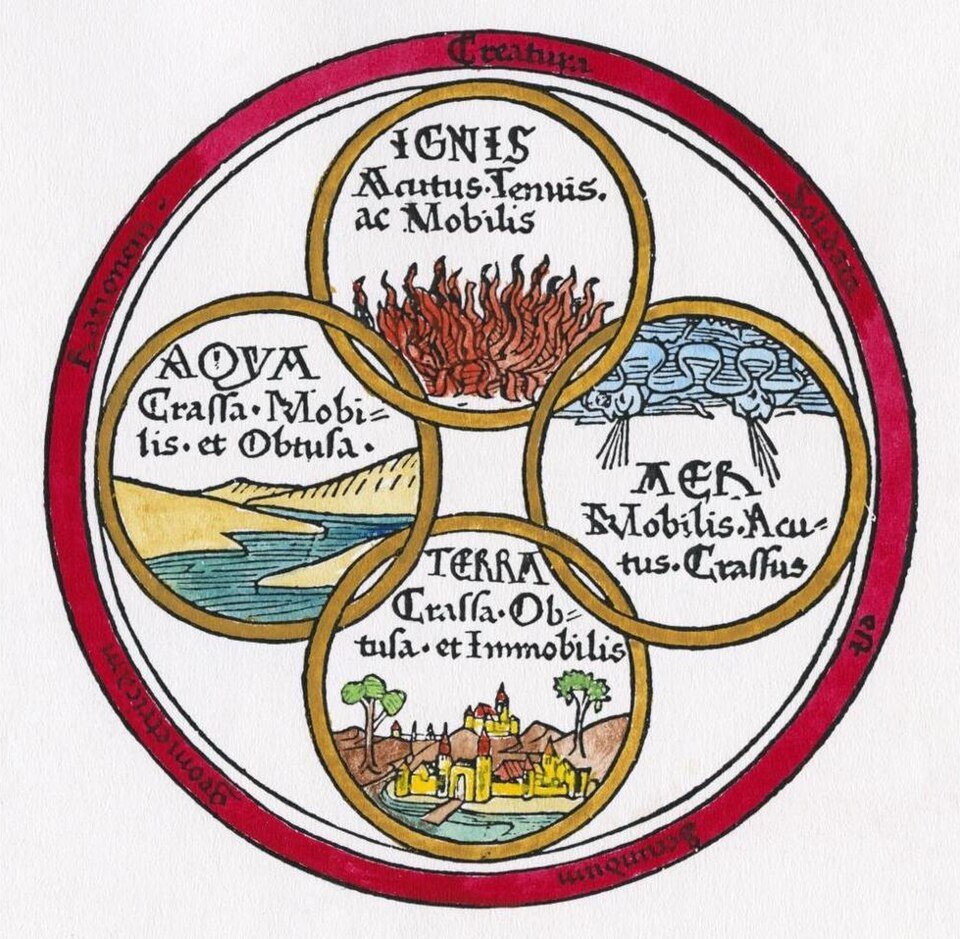
The ancient Greek tradition, particularly through the teachings of Hippocrates and Galen, developed the theory of the four humours – blood, yellow bile, black bile and phlegm – associated with the four elements – air, fire, earth and water. Each was associated with two qualities:
Blood (Air): hot and moist
Yellow bile (Fire): hot and dry
Black bile (Earth): cold and dry
Phlegm (Water): cold and moist
Health depended upon maintaining an appropriate balance between these humours. Medicinal plants were classified according to their own qualities and used to correct imbalances. A warming herb, for example, might be prescribed for a condition characterised by excessive cold.
Ayurveda
The Indian tradition of Ayurveda developed its own system based on five elements and three fundamental principles, or doshas: Vata, Pitta and Kapha.
Each dosha possesses characteristic qualities. Vata is predominantly cold and dry, Pitta hot, and Kapha cold and moist. Disease arises when these principles become disturbed.
Medicinal plants are selected partly according to their qualities, with the general principle that opposing qualities help restore balance. Warming and moistening herbs, for instance, may be appropriate for conditions characterised by coldness and dryness.
Traditional Chinese medicine
Chinese medicine employs a different theoretical framework, centred on Yin and Yang, Qi and the Five Phases. Nevertheless, the distinction between Cold and Heat is fundamental to diagnosis.
Medicinal plants are classified as cold, cool, neutral, warm or hot, and also according to their tastes and other properties. Cooling herbs are used to clear Heat, while warming herbs help dispel Cold. Other qualities, such as drying, moistening, dispersing and tonifying, further determine their therapeutic applications.
Unani medicine
Unani, whose name derives from the Greek word for Greek, represents the clearest historical link between these traditions. Based upon the medicine of Hippocrates and Galen, it was preserved and developed by physicians in the medieval Islamic world, notably Avicenna and Al-Razi.
Unani retains the four fundamental qualities and applies them to both human constitutions and medicinal substances. Each individual possesses a particular temperament, while herbs are classified according to their own temperaments and degrees of intensity.

A history of exchange
These traditions did not develop in complete isolation. For centuries, merchants, physicians and scholars travelled between the Mediterranean, Persia, India and China, carrying medicinal plants, medical texts and knowledge.
Greek medical works were translated into Arabic and developed by Islamic physicians. Indian medical knowledge also entered the Arabic and Persian scholarly worlds, while Greek and Indian cultures came into closer contact during the Hellenistic period.
The Silk Road and maritime trading networks facilitated the movement of medicinal substances and botanical knowledge between East and West. Chinese medicine participated in these exchanges, although its fundamental theoretical system developed along a distinct historical path.
It is therefore reasonable to recognise both independent development and the probable transfer of medical ideas, although the extent of direct influence varies considerably between traditions.
The enduring importance of the four qualities
For the traditional herbalist, these systems offer something particularly valuable: a coherent way of understanding medicinal plants in relation to the patient and the illness.
Rather than simply memorising which herb treats which complaint, the practitioner considers the nature of the condition and the qualities of the remedy.
Is the condition hot or cold? Is there excessive moisture or dryness? Does the patient require warming, cooling, drying or moistening?
Modern pharmacology provides a different and increasingly sophisticated understanding of medicinal plants, but it does not invalidate the historical significance of these traditional classifications.
The four qualities remain a remarkably useful starting point for exploring the herbal knowledge accumulated over centuries by physicians and herbalists across the Old World.
Despite their different philosophies and languages, these traditions shared a fundamental conviction: understanding the nature of a medicine is as important as understanding the nature of the disease.
Top image: Empedocles four elements (fire, air, water and earth), colored woodcut from an edition of Lucretius De rerum natura, published by Tommaso Ferrando, Brescia, 1472. Source: Wikimedia Commons. Public domain.